Hazel Tries to Persuade Her Father to Accept Cancer Treatment
Made for LoveHazel Tries to Persuade Her Father to Accept Cancer Treatment is a confrontation over illness, autonomy, and the strained tenderness between Hazel and her father, Herbert. When Byron tells her the cancer is widespread, Hazel returns home prepared to offer treatment and care on her father’s terms. Her appeal cannot change his decision: he wants to remain at home and is done with treatment, forcing Hazel to face both his approaching death and the limits of what she can do for him.
The Diagnosis and What Hazel Learns
The effort begins with information Hazel receives from Byron. After asking about Liver’s health, she asks what her father’s scan showed. She braces herself for what Byron might say, suspecting that his answer could be a lie or a half-truth. Instead, he tells her that the cancer is widespread and that her father does not have long.
Hazel initially resists the diagnosis. Her mother also died of cancer, and the prospect of her father following the same course feels almost impossible to accept. She reasons that he had only just seen a doctor, should have symptoms if the disease were so advanced, and would know if something were wrong. She then recognizes that her assumptions about his openness do not fit what she knows of him: he tends to minimize pain and keep going.
Byron says her father already knows. Although the helmet was not designed primarily as a medical scanner and could not provide the precision of a HealthSweep imager, Byron says he consulted several doctors on her father’s behalf. They agreed that the available information indicated he had undergone chemotherapy and radiation, then stopped everything except pain medication a few months earlier. Byron also says that, if it were legal, he would have checked hospital records to confirm the history. His disclosure therefore changes the issue for Hazel: she is not only confronting a grim diagnosis, but learning that her father has privately chosen to stop treatment.
An Offer Made on Her Father’s Terms
Hazel looks back on the signs she had not questioned. There had been hundreds of pills beneath the sink; her father had acquired two sex dolls; and he seemed prepared to spend the rest of his life without a car. She sees that she had grown used to not questioning what he wanted and, by extension, not asking why. Her realization gives the news a second weight: his secrecy has been possible partly because she had stopped trying to understand his reasoning.
Byron frames treatment as a possible alternative to that decision. He acknowledges that the news may hurt Hazel, then argues that her father probably chose based on the limited options available to him financially. More tests would be needed, but Byron says he could give him access to cutting-edge treatment unavailable to the general public and that there was hope. Hazel recognizes the leverage in Byron’s offer: he is using her father’s condition to draw her back. Yet she also feels a twisted gratitude, because help for her father matters more to her than winning their conflict outright.
Hazel weighs that choice against the freedom she has claimed while away from Byron. She does not want her return to mean that he has simply defeated her; returning to sit at his side out of loyalty to her father feels closer to a draw. She asks whether Byron expects her to move back to The Hub. He says that would make the most sense and presents her father, if they are together, as his family too. Hazel points to the contradiction: the offer comes from the husband she has left, who implanted a chip in her brain. Her return is thus bound up with both a family crisis and the surveillance and control she has sought to escape.
The Appeal at Home
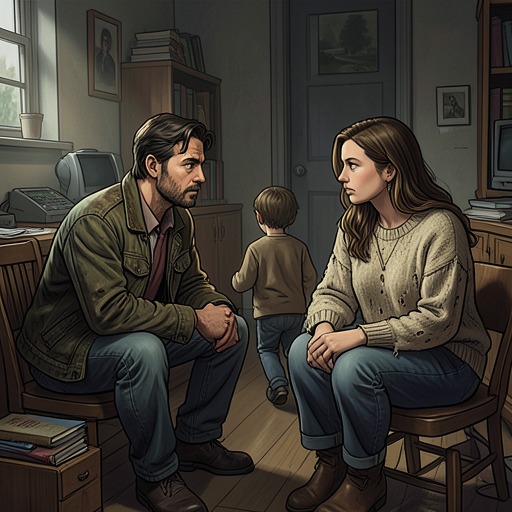
Hazel goes to her father’s house and finds him sitting between Diane and a newer red-haired doll. He tells her that she should have knocked. In response, she leaves a brick of cash on the coffee table, explaining that it amounts to about a year’s rent, and offers a different kind of help: she will take him to Gogol’s medical facilities.
The proposal is carefully shaped around his independence. Hazel says he can pack a suitcase and they can take a cab; she will not make him talk about cancer, and they can discuss the weather, baseball, or the ways she has disappointed him instead. She offers to visit every day or give him space, promising to let him call the shots. The money and the offer of treatment are concrete, but so is her effort not to turn care into a demand for emotional closeness. She makes room for his preferences even while asking him to reconsider a decision she finds unbearable.
Her father answers that it is his life and that he can decide what happens to it. Hazel agrees with the principle, then urges him not to give up and die. She asks whether his refusal is connected to her mother and what he saw during her treatments. He does not give that explanation. He says he is done, wants to spend the short time left in his own home, and is content to be surrounded by beautiful women, even if they are replicas. His choice is starkly specific: not an abstract rejection of life, but a wish to remain in familiar surroundings without further treatment.
Refusal, Affection, and the Limits of Persuasion
Her father explains that he did not tell Hazel because he expected her to push him toward what he considered a crackpot laboratory. He says the decision is not a punishment or a judgment on their relationship: even if they got along better, he would not want to try to live forever. He has chosen to stop treatment, and Hazel’s offer does not overturn that choice.
The refusal unsettles the distance that has long structured their relationship. Hazel has wanted him to rebuke her or blame her, anything that would restore the familiar separation between them. Instead, his smile and his use of the childhood name Hazelbear draw her closer. He says he had hoped she would be moving on by the time his condition became difficult, because he wanted to spare her. When she tells him she will stay with him until the end, he appreciates the offer but warns that the trouble surrounding her is at an all-time high.
The scene leaves Hazel’s practical appeal unanswered but clarifies what care can and cannot accomplish between them. She can bring money, offer treatment, and promise her presence; she cannot make her father want more medical intervention. His refusal makes her return to his home an act of companionship rather than a successful rescue, while the strained affection between them briefly surfaces through the very decision that separates their wishes.